
Colour the World
Puzzle Design
Colour the World is my 4th Year Capstone Project at Sheridan College. I took on many roles in this project, including designing puzzles and assisting with level design.
While designing the game’s colours, I began to sketch out some preliminary puzzles. Alot of these preliminary puzzles were a hit with the rest of the team, so they left me in charge of designing some more puzzles for the game. Thus, I was promoted to the role of puzzle/level designer!
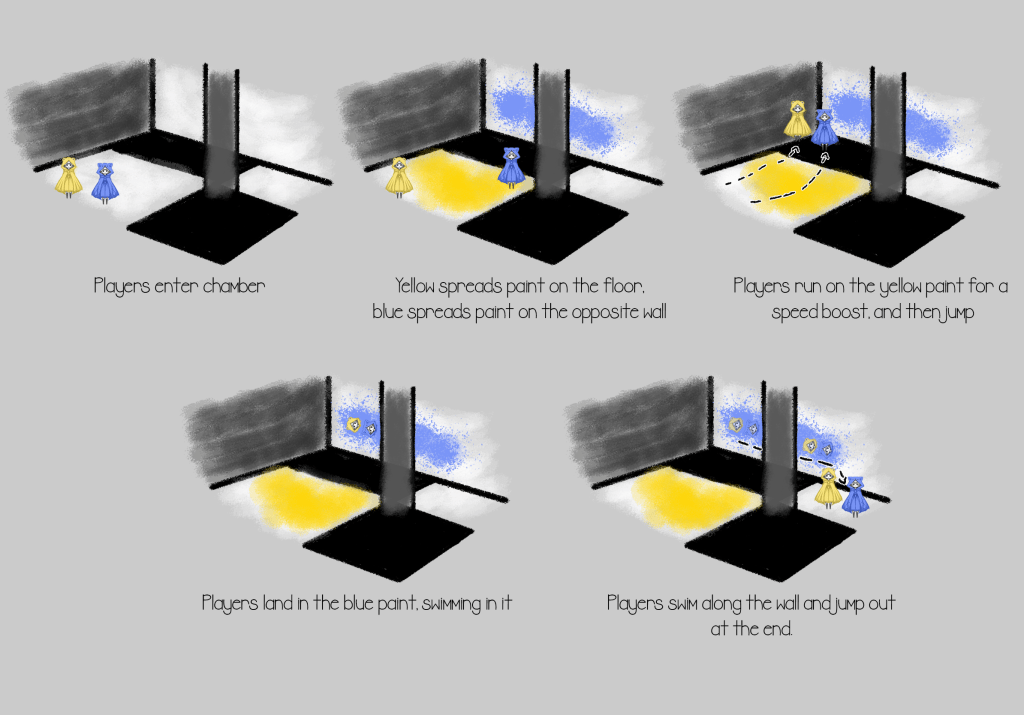
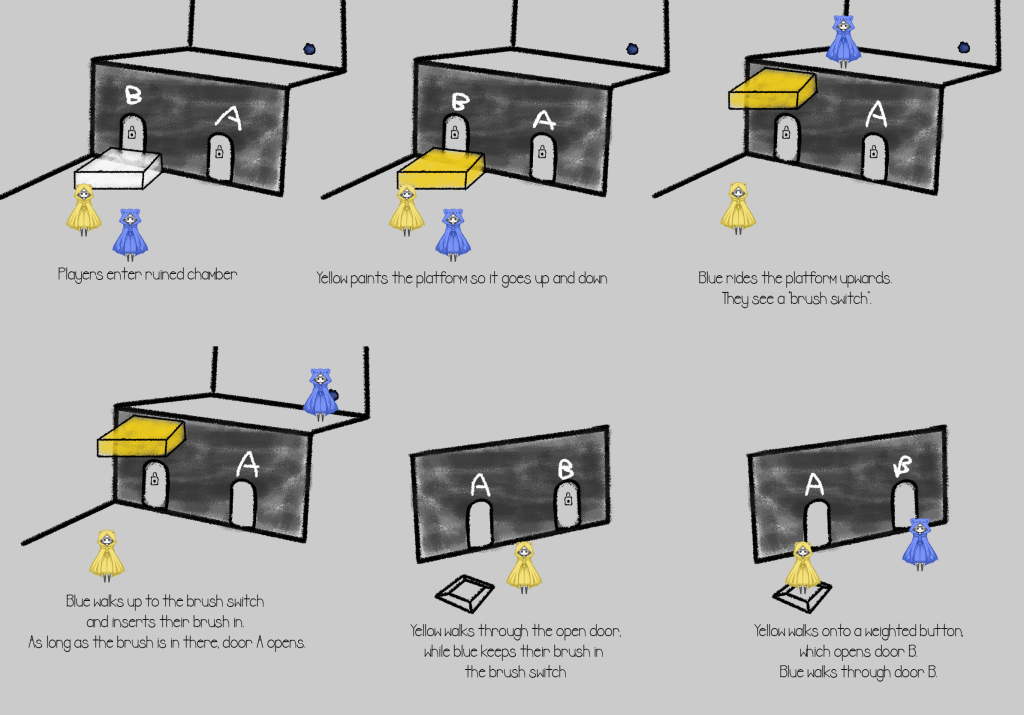
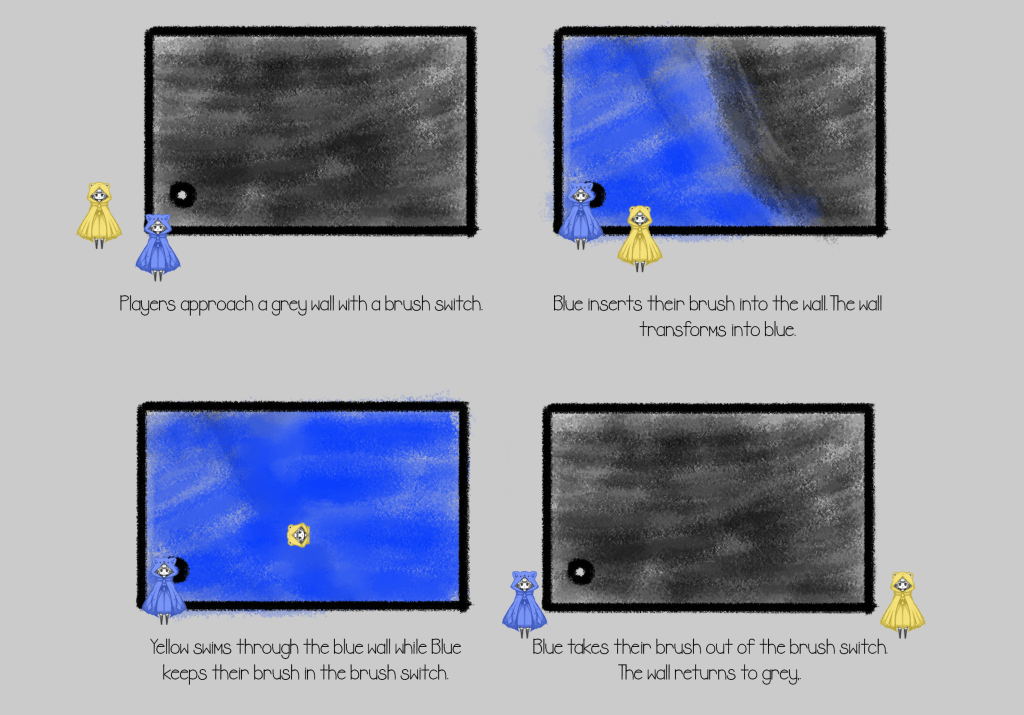
I decided to first design puzzles without worry of scope or how difficult they would be to implement. This allowed us to explore some unique concepts that we might not have considered before, like pressure switches, applying paint to walls, and having certain objects/surfaces that could not be painted. Many of these mechanics were not implemented due to time constraints, but some (such as unpaintable surfaces and pressure switches) did manage to make it into the final product. We weeded out the concepts we didn’t like / wouldn’t be possible, and I went forward designing puzzles using the mechanics that were left.
While I was designing puzzles, others were working on the layout of the level. I was handed the level’s layout and asked to plot out where the puzzles I designed would go. The result can be seen above; I numbered each of the puzzles as well, and a more in-depth description was given in the pages following it. The layout did go through some changes during the implementation phase but remained mostly similar to this.
Postmortem – Puzzle Design
Since I spent so much time designing our game’s colours, it made sense that I would move onto designing puzzles, but I didn’t expect the overwhelmingly positive response that the team had to my puzzle designs! Frankly, it was quite flattering.
I had alot of fun designing puzzles and level mechanics for our game. I wanted to first design without worrying about the constraints of implementation, and then have others tell me what would be possible and what would not be. That allowed us to have a wider variety of puzzles in our game, and also let us get excited over how much opportunity our game’s mechanics afforded us. To me, this excitement is imperative, as I believe excitement and motivation are crucial to developing a quality product.
Our art team created a beautiful statue that would be on display in the 3rd room of the game. I was inspired by how striking the statue was, and found myself wanting to interact with it; after all, it was such a centerpiece of the level’s visual aesthetic, so why not make it a centerpiece of the level’s puzzles as well?
I designed the statue to have 3 different functions depending on what colour it was painted – it essentially became a switch that enabled 3 other puzzles. Only 1 of these puzzles could be active at any given time, so players would have to return to the statue if they wanted to solve one of the other puzzles. So, when players turned the statue blue, a previous room would become flooded. When turned green, it would make mushrooms sprout all over the floor that players could climb up. And then, when turned yellow, a previously unpaintable surface would turn yellow so that players could interact with it. The statue now felt just as impactful as it looks!
My only real regret is that we ran out of time to create and design a second level, as this would have given me more opportunities to design puzzles with unique mechanics. I would have loved to have been able to make more puzzles that made use of our full range of colours, but it wasn’t realistic given our scope.
 andrewguagliano.ca